Kubernetes vs Shepherd: A Minimal Orchestrator
Written by:
Igor Gorovyy
DevOps Engineer Lead & Senior Solutions Architect
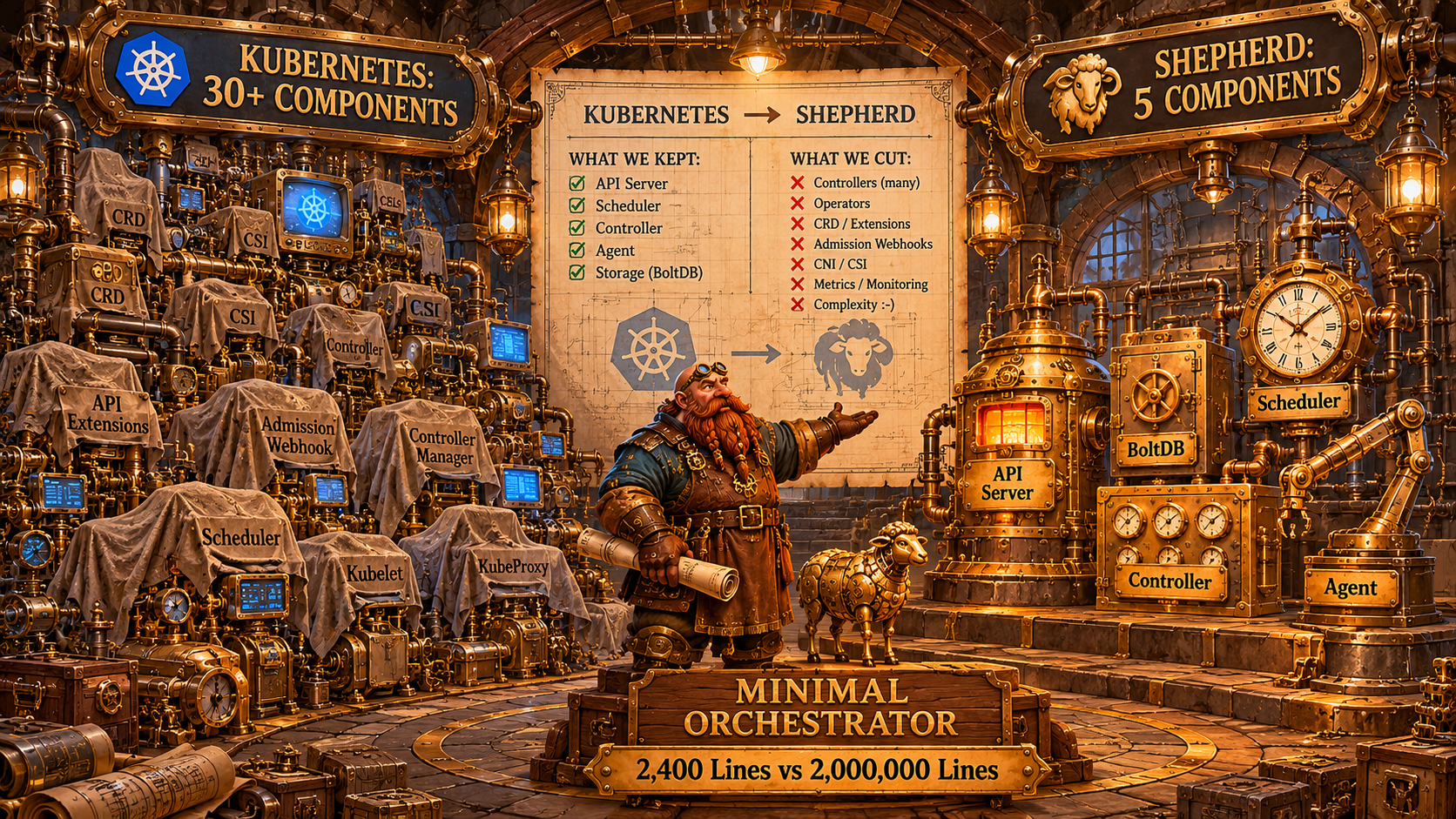
Kubernetes consists of dozens of components. Shepherd implements five. Here's what turned out to be the bare minimum for a working orchestration system, and what we intentionally cut.
What Stayed
graph TB
    subgraph "Present in both"
        API["API Server<br/>K8s: kube-apiserver<br/>Shepherd: net/http REST"]
        STORE["State Store<br/>K8s: etcd cluster<br/>Shepherd: BoltDB file"]
        SCHED["Scheduler<br/>K8s: kube-scheduler<br/>Shepherd: filter + score"]
        RC["Replication Controller<br/>K8s: ReplicaSet controller<br/>Shepherd: reconcile loop"]
        SC["Service Controller<br/>K8s: endpoints controller<br/>Shepherd: label matching"]
        NC["Node Controller<br/>K8s: node lifecycle controller<br/>Shepherd: heartbeat timeout"]
        AGENT["Node Agent<br/>K8s: kubelet<br/>Shepherd: Agent"]
        CLI["CLI<br/>K8s: kubectl<br/>Shepherd: sheepctl"]
        EVENTS["Events<br/>K8s: events API<br/>Shepherd: events bucket"]
    end
That's 9 components. Kubernetes has 30+. The difference is what we cut.
What We Cut and Why
| K8s Component | What it does | Why we cut it |
|---|---|---|
| etcd cluster | Distributed consensus | BoltDB is enough for single-node |
| Admission webhooks | Validation/mutation on create | Can validate in API handlers |
| RBAC | Authorization | Single user, no need |
| Service Accounts | Pod identity | No auth system |
| Secrets/ConfigMaps | Configuration and secrets | Pods take env directly |
| HPA | Autoscaling | Scale manually via sheepctl |
| CRDs | Custom resources | Fixed set of resources |
| CNI | Network plugin interface | One hardcoded bridge |
| CSI | Storage plugin interface | Volumes via bind mounts |
| kube-proxy | Service routing (iptables) | Endpoints as IP list |
| Ingress | HTTP routing | None |
| Watch API | Long-poll for changes | Ticker-based polling |
| Leader election | HA controller manager | Single instance |
| PodDisruptionBudget | Controlled eviction | No eviction |
| Rolling updates | Zero-downtime deploys | Delete + recreate |
What We Learned: The Minimal Orchestrator
After building Shepherd, it became clear that container orchestration across multiple nodes needs exactly five things:
1. API Server - a single entry point. All components communicate through it. Without a central API, each component would need to know about every other one.
2. Persistent Store - the cluster state must survive restarts. Even an embedded DB is enough.
3. Scheduler - a node selection algorithm. Without it, you'd have to manually specify the node for every pod.
4. Controllers - reconciliation loops. Without them, "I want 3 replicas" doesn't work - you'd have to manually create each pod.
5. Agent - someone on the node has to turn "pod is assigned here" into actual running containers.
Everything else is a production extension: - Admission = input validation - RBAC = who can do what - CRD = extensibility - CNI/CSI = pluggable infrastructure - Watch = reactivity instead of polling
Comparison in Numbers
| Metric | Kubernetes | Shepherd |
|---|---|---|
| Lines of code | ~2,000,000 | ~2,400 |
| Go modules | ~400 | ~2 (bolt, unix) |
| Resource types | 60+ | 5 (Pod, Service, Deployment, Node, Event) |
| API endpoints | 200+ | ~15 |
| Controllers | 30+ | 3 |
| Min RAM | 2GB+ | ~20MB |
Honest About Limitations
Shepherd is not production-ready:
- Single point of failure - one API Server, one BoltDB file. Server goes down, the cluster is dead.
- No TLS - all traffic is plain HTTP. Agent to API, sheepctl to API.
- No auth - anyone can create/delete pods.
- No rolling updates - scale down + scale up, with downtime.
- No pod networking - containers in a pod don't share a network namespace.
- No DNS - IP addresses only, no service discovery by name.
- No health checks - liveness/readiness probes are missing.
But Shepherd shows that these 2400 lines are the skeleton on which Kubernetes's 2 million lines are built. All the same patterns: reconciliation, label selectors, async scheduling, desired state.
K3s - A Real Minimal Kubernetes
If you need a production-ready minimal orchestrator, check out K3s by Rancher. They did the same thing: replaced etcd with SQLite, bundled containerd, stripped cloud provider integrations. Single binary, ~100MB, full Kubernetes API compatibility.
The difference: K3s is production ready. Shepherd is educational.
Honest About Downsides
Without TLS and auth, anyone with network access can create and delete pods. That's acceptable for localhost, but for multi-node over a network it's a security hole. Adding TLS and auth means ~500 more lines of code and certificate management.
Two more things that are easy to underestimate:
- Ticker polling instead of Watch scales badly. Every controller reads the entire state once per interval. Fine for dozens of resources, but at thousands the CPU burns re-reading objects that never changed.
- BoltDB is single-writer. All writes serialize through one transaction. Fine for single-node, but it's a fundamental ceiling: it doesn't scale horizontally the way a Raft-based etcd cluster does.
💡 Fun facts
- Kubernetes grew out of Borg, Google's internal orchestrator. The word "kubernetes" is Greek for "helmsman"; that's where the abbreviation "k8s" (8 letters between "k" and "s") and the ship's-wheel logo come from.
- etcd is named the way it is on purpose: it's "/etc" + "distributed" - a distributed config store for the cluster. It uses Raft for consensus, which is exactly why Kubernetes recommends an odd number of nodes (3, 5, 7) by default - for quorum.
- kube-scheduler actually runs in two phases, just like Shepherd: first filter (drop unfit nodes), then score (rank the rest). The same pattern we implemented in a few dozen lines.
- Rancher's K3s stripped roughly a million lines of cloud-provider and legacy code from the binary, then wrapped the result so it still passes the full Kubernetes conformance test. "Minimal" doesn't mean "fake."
What I figured out while digging into this
My biggest takeaway was how much of Kubernetes's code goes not into orchestration but into extensibility. CRDs, admission webhooks, CNI, CSI - these are all mechanisms to let other people plug in without touching the core. The orchestration itself - reconcile loop + scheduler + store - is surprisingly small.
I expected the hard part to be scheduling or networking. It turned out the skeleton rests on a single idea: desired state vs actual state, and a loop that reconciles them. Everything else is plumbing around that one loop.
What could be improved
- Replace ticker polling with a simple long-poll Watch endpoint - it's doable even on net/http and removes the main inefficiency of the controllers.
- Add health checks (liveness/readiness): without them a Pod counts as alive until the process dies, even though the app inside may have been returning 500s for ages.
- Extract the scheduler logic into a plugin interface (filter/score as separate functions) - a good exercise to feel how a real scheduler framework is built.
- Add rolling updates to the ReplicationController instead of delete+recreate: scale up the new version, wait for Ready, then scale down the old one.
Try It Yourself
# Shepherd - one binary:
ls -lh ./shepherd        # ~10MB
# All state - one file:
ls -lh /var/lib/shepherd/shepherd.db
# Compare with K8s:
# etcd cluster + kube-apiserver + kube-scheduler + ...
Next up - where containers, images, and cluster state physically live on disk.
Resources
- Kubernetes Components: full architecture
- Kubernetes architecture: deeper dive
- Borg, Omega and Kubernetes: historical context
Source code for the series: github.com/igorgorovoy/sheep-shepherd-meadow
Previous: Docker vs Sheep | Next: Filesystem Layout