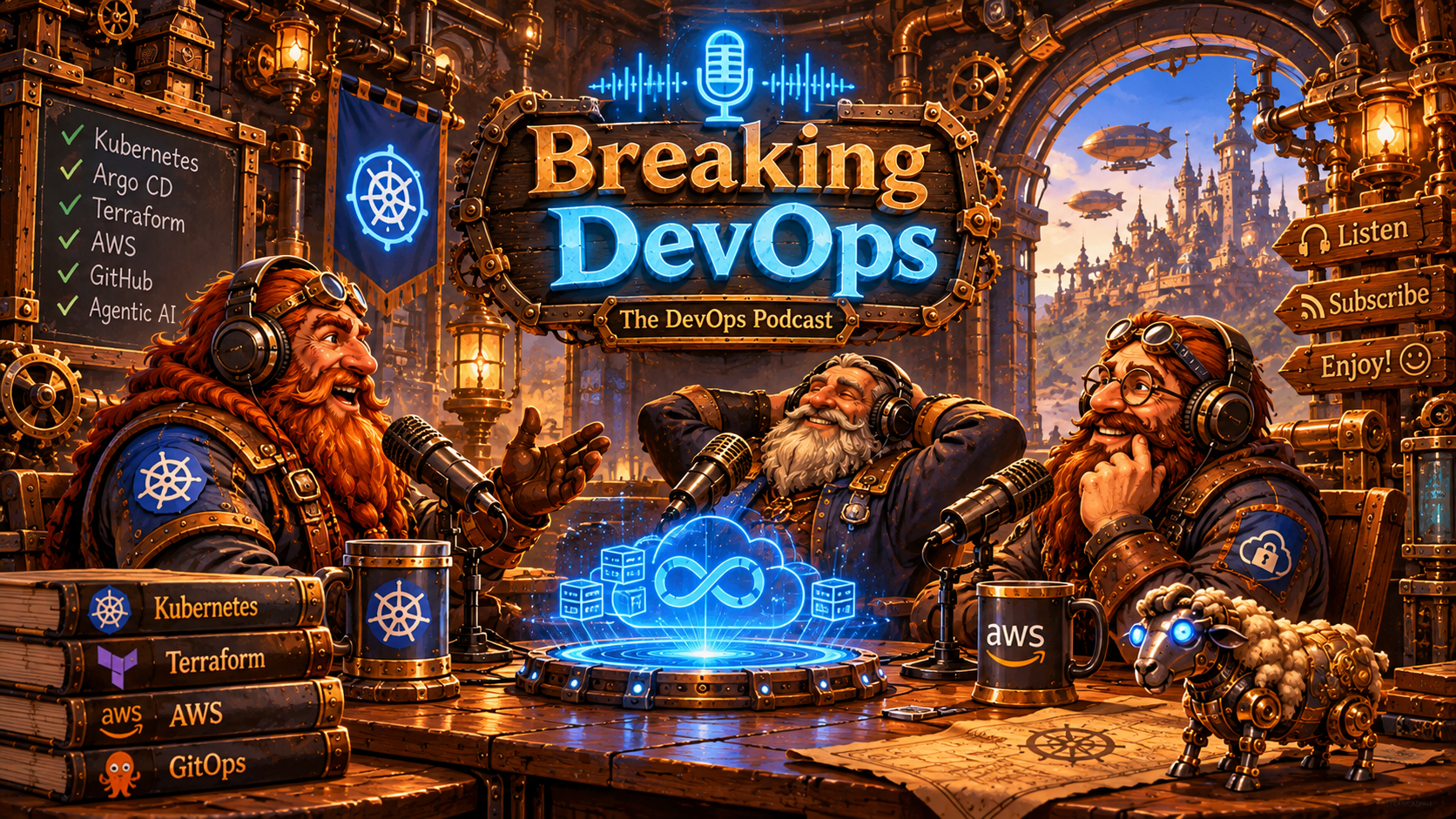
Breaking DevOps: a podcast that collects my DevOps week
Українська версія · Listen in English · Слухати українською
Why
By the end of a week I have a pile of open tabs: the Kubernetes blog, Argo CD and Terraform releases, AWS announcements, something from Hacker News, posts about agentic development. I have no time to read them at a desk. But I do have time on a walk, on the metro, or standing in a queue.
So the idea is simple: every Sunday, get 30 minutes of audio on topics I actually care about. Not general IT news, but DevOps and everything around agentic development. You listen in a regular podcast app, like any other show.
DevOps podcasts already exist, but someone else picks the topics and the pace. Here I pick.
What the listener gets
Two episodes come out every Sunday, one in Ukrainian and one in English. Three dwarf hosts, Brokk, Sindri and Runa, cover 6-8 topics of the week. Once per episode they mention the editor-in-chief, Ingwar. That is me.
You can listen on a web page or subscribe to the RSS feed in an app. Access is a personal link with a token, no sign-up.
How it works
flowchart LR
  collect["Collection twice a day:<br/>blogs, releases, HN"] --> items[("items of the week")]
  me["Me in the admin:<br/>✓ / ✕ / my own links"] --> items
  items --> sel["Claude: topics of the week"]
  sel --> fetch["VM fetches articles"]
  fetch --> uk["Claude: uk script"]
  uk --> en["Claude: en adaptation"]
  uk --> tts1["Gemini TTS"]
  en --> tts2["Gemini TTS"]
  tts1 --> pub[("MP3, page, RSS")]
  tts2 --> pub
Collection. Twice a day a timer pulls new entries from RSS: Kubernetes, CNCF, Argo, Flux, AWS What's New, HashiCorp, GitHub Changelog, Cloudflare. Plus GitHub releases (Kubernetes, Argo CD, Flux, Terraform, OpenTofu, Prometheus, Grafana, Helm, Cilium, Istio) and Hacker News stories above 50 points. No LLM at this step, just rows in SQLite.
Editing. During the week I open the admin page and go through the list. ✓ means "must be in the episode", ✕ means "drop it", no mark means Claude decides. Agentic development mostly comes in here: a post about agents I found somewhere else goes in as my own link and gets a ✓ automatically. If the page can't be fetched (Medium, Substack, a paywall), I paste the text by hand.
Script. Three Claude calls:
- Topic selection. Claude sees only titles and summaries, groups them into 6-8 topics and explains why each matters. Topics aired in the last 14 days come in a separate block, so it doesn't repeat them.
- Code, not the model, fetches the articles behind each topic: up to three per topic, up to 15 thousand characters of text.
- For each topic Claude first writes a brief for the hosts with facts from the articles, then the lines. If an article didn't load, the hosts have to say plainly that there are no details.
The English episode is an adaptation, not a translation: the same topics and facts, but English phrasing, with versions and numbers checked against the articles.
Voice. Gemini TTS, each chunk up to 3500 characters and up to two voices per request. Then PCM to MP3, 64 kbps mono.
Every step is cached. I can build a draft, look at the topics and the script, drop a topic, rewrite the script, and only then generate audio. If something fails halfway, the finished steps are not paid for twice.
What it costs
A 30-minute draft with 8 topics and 16 articles in Ukrainian: 55 thousand input and 36 thousand output Claude tokens, $0.94. The English adaptation adds $0.3-0.4, voice is about $0.4 per language. In total $2-2.5 a week for both languages.
The first version was a daily 15-minute show, and Claude read the articles itself through web_fetch. That cost $2.62 per episode: the server-side loop re-read the whole context after every article, and one episode came to 475 thousand input tokens. So now code fetches the articles and Claude gets the finished text.
What went wrong
Cloudflare Workers. At first everything lived on Workers: site, RSS, generation in a Workflow, D1 and R2. But on the free plan a Worker gets 10 ms of CPU per call, and MP3 encoding takes about 8 seconds. Production was only a shop window; I generated episodes locally and uploaded them by hand. A day later everything moved to a VM in Proxmox behind a Cloudflare Tunnel: Bun, SQLite, systemd timers. The collection, script and voice logic did not change.
Keywords for AWS. At first AWS What's New was filtered by keywords. The filter cut Route 53, Lambda and databases, and let through marketing with the word "agent". Now it works the other way: obvious noise is dropped (Marketplace, partners, media services, Connect), and Claude picks the topics.
Limits
- The voices were picked without listening. Nobody has listened to a full English episode yet, and pronunciation of versions and names may be odd.
- An article can influence the script. Claude has no tools, and texts go in separate tags with a rule not to follow instructions from them. That lowers the risk but does not remove it.
- Listening stats are rough. An app with auto-download fetches the whole file even if nobody listened.
- The Sunday timer is off for now: I publish from the admin page after reviewing the draft. There is no backup of the database and MP3 outside the VM yet.
- The automatic collection has no dedicated agentic-development sources. That part relies on my own links and special episodes.
Special episodes
Besides the Sunday review, I can build a themed episode from my own material: a date, a topic, a brief and a list of links. In RSS it comes out as "Special:
Listen
- English: podcast.steamkube.dev/en
- Українською: podcast.steamkube.dev
The page links to the RSS feed: you can add it to Apple Podcasts, Pocket Casts or any other app that subscribes by URL.