Pull from regestry: Auth, Manifest Lists, Multi-Arch
Written by:
Igor Gorovyy
DevOps Engineer Lead & Senior Solutions Architect
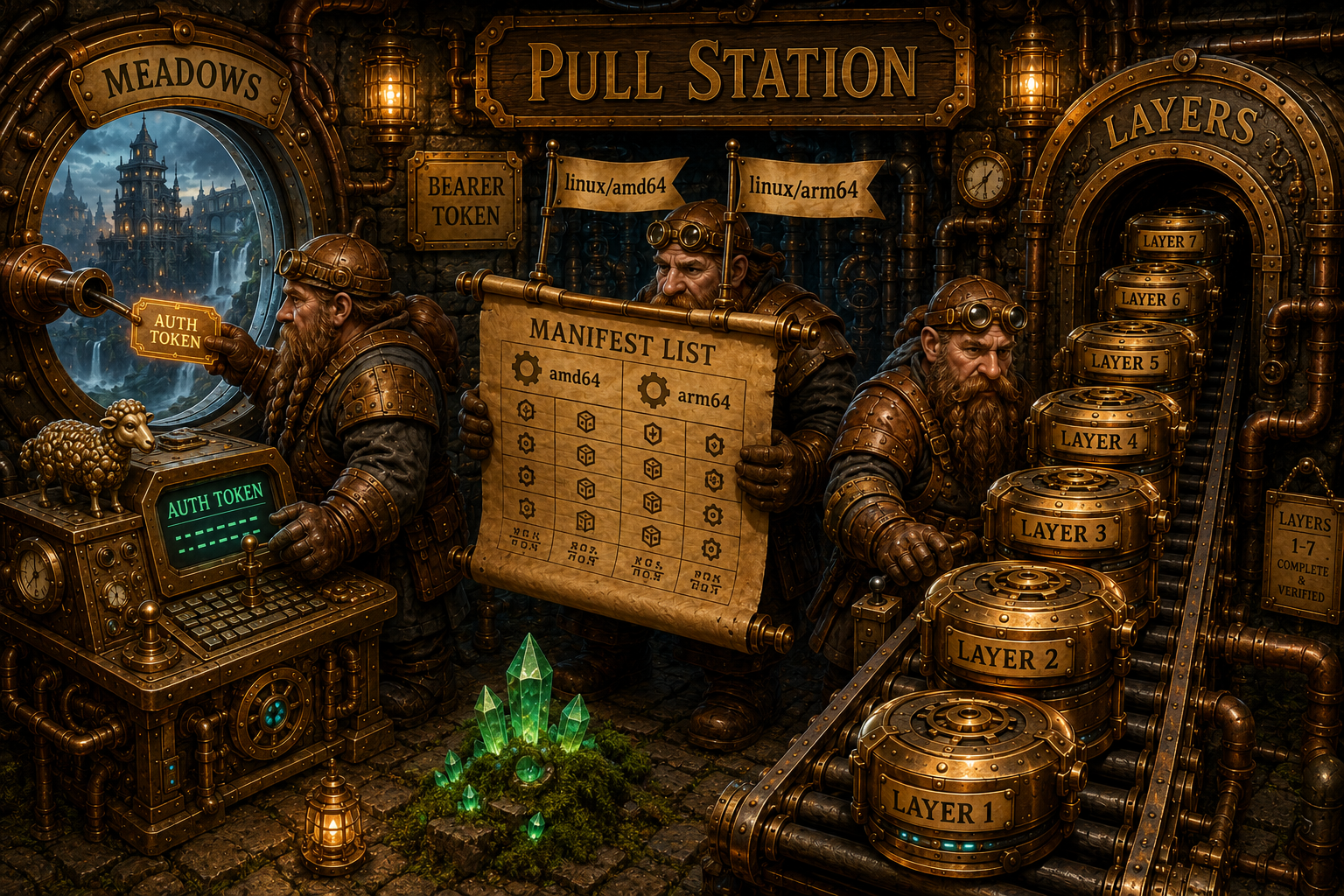
sheep pull nginx - one command, but under the hood: reference parsing, token retrieval, manifest list handling for multi-arch, layer downloading. Let's walk through each step.
Parsing the image reference
func ParseImageRef(s string) ImageRef {
    ref := ImageRef{Tag: "latest"}
    // "nginx" → registry-1.docker.io/library/nginx:latest
    // "user/repo:v2" → registry-1.docker.io/user/repo:v2
    // "ghcr.io/user/repo:tag" → ghcr.io/user/repo:tag

    if i := strings.LastIndex(s, ":"); i > 0 &&
        !strings.Contains(s[i:], "/") {
        ref.Tag = s[i+1:]
        s = s[:i]
    }

    parts := strings.Split(s, "/")
    switch {
    case len(parts) == 1:
        ref.Registry = "registry-1.docker.io"
        ref.Repo = "library/" + parts[0]
    case len(parts) == 2 && !strings.Contains(parts[0], "."):
        ref.Registry = "registry-1.docker.io"
        ref.Repo = s
    default:
        ref.Registry = parts[0]
        ref.Repo = strings.Join(parts[1:], "/")
    }
    return ref
}
nginx without slashes is a Docker Hub official image (library/nginx). user/repo without a domain is Docker Hub too. If there's a dot in the first part (ghcr.io), it's a different registry.
Auth: Bearer Token
Docker Hub requires a token for pull. Here's how to get one:
func (rc *RegistryClient) getToken(ref ImageRef) (string, error) {
    if ref.Registry == defaultRegistry {
        url := fmt.Sprintf(
            "%s?service=%s&scope=repository:%s:pull",
            dockerAuthURL, dockerService, ref.Repo)
        resp, _ := rc.client.Get(url)

        var tokenResp struct {
            Token string `json:"token"`
        }
        json.NewDecoder(resp.Body).Decode(&tokenResp)
        return tokenResp.Token, nil
    }
    return "", nil // anonymous for other registries
}
sequenceDiagram
    participant C as Sheep
    participant A as auth.docker.io
    participant R as registry-1.docker.io

    C->>A: GET /token?service=registry.docker.io&scope=repository:library/nginx:pull
    A->>C: {"token": "eyJhbGci..."}
    C->>R: GET /v2/library/nginx/manifests/latest<br/>Authorization: Bearer eyJhbGci...
    R->>C: manifest list (multi-arch)
Manifest list: multi-arch
Modern images on Docker Hub have a manifest list - an index containing manifests for different platforms:
func (rc *RegistryClient) getManifest(registryURL string,
    ref ImageRef, token string) (*manifestResponse, error) {

    accepts := []string{
        "application/vnd.oci.image.index.v1+json",
        "application/vnd.docker.distribution.manifest.list.v2+json",
        "application/vnd.oci.image.manifest.v1+json",
        "application/vnd.docker.distribution.manifest.v2+json",
    }

    body, mediaType, _ := rc.registryGet(url, token,
        strings.Join(accepts, ", "))

    if strings.Contains(mediaType, "list") ||
        strings.Contains(mediaType, "index") {
        var ml manifestList
        json.Unmarshal(body, &ml)

        // Look for linux/amd64
        digest := ""
        for _, m := range ml.Manifests {
            if m.Platform.OS == "linux" &&
                m.Platform.Architecture == "amd64" {
                digest = m.Digest
                break
            }
        }
        if digest == "" {
            digest = ml.Manifests[0].Digest
        }

        // Fetch the specific manifest
        body, _, _ = rc.registryGet(
            registryURL+"/v2/"+ref.Repo+"/manifests/"+digest,
            token, singleAccepts)
    }

    var manifest manifestResponse
    json.Unmarshal(body, &manifest)
    return &manifest, nil
}
Downloading layers
func (rc *RegistryClient) pullLayer(registryURL string,
    ref ImageRef, token, digest, rootfs string) error {
    url := fmt.Sprintf("%s/v2/%s/blobs/%s",
        registryURL, ref.Repo, digest)

    req, _ := http.NewRequest("GET", url, nil)
    if token != "" {
        req.Header.Set("Authorization", "Bearer "+token)
    }

    resp, _ := rc.client.Do(req)
    defer resp.Body.Close()

    return extractLayer(resp.Body, rootfs)
}
Each layer is a gzip-compressed tar archive. Layers are applied sequentially, each adding or removing files (via whiteout).
Result
$ sheep pull nginx
pulling manifest for nginx:latest
pulling layer 1/7 a1b2c3d4e5f6
pulling layer 2/7 f6e5d4c3b2a1
...
pulled nginx:latest (180.5 MB)
What's not ideal here
Layers are downloaded sequentially. Docker downloads them in parallel, which is significantly faster for images with many layers. There's also no layer caching between pulls of different tags of the same image.
- The token is anonymous and short-lived. On a large image it can expire mid-pull, and the registry returns
401halfway through downloading layers. Our client doesn't handle this: you'd need to catch the401and re-fetch the token. - The
linux/amd64choice is hardcoded. On an ARM machine (Apple Silicon, Graviton) this silently downloads the wrong architecture, and the container dies withexec format errorinstead of a clear message. - The auth server address is hardcoded for Docker Hub. Per the spec you aren't supposed to know it up front: the registry returns a
401with aWWW-Authenticate: Bearer realm="...",service="...",scope="..."header, and the client is meant to follow thatrealm. Our code works against Docker Hub and silently falls back to anonymous everywhere else, so it can't pull from a private GHCR or ECR at all. - Matching the platform on
OSandArchitecturealone is incomplete. The index also carriesvariant(v7for 32-bit ARM,v8for arm64) andos.versionfor Windows. Withoutvariant, 32-bit ARM can pick the wrong image and land back onexec format error. - The
digest = ml.Manifests[0].Digestfallback looks safe and isn't: modern indexes sit images next to attestation manifests (SBOM, provenance) withplatform: unknown/unknown. Instead of "grab the first one if ours isn't there", it should either return an honest error or at minimum filter outunknown.
💡 Fun facts
docker pull nginxnever talks todocker.iodirectly - it goes toregistry-1.docker.io, and for the token to a separateauth.docker.io.docker.ioitself is just a website. Splitting the auth server from the registry is part of the Bearer token scheme from RFC 6750.- The
library/prefix for official images is a historical leftover. That's whynginxis reallylibrary/nginx, and exactly why the code has a separate branch for an image with no slashes. - The manifest list (OCI image index) is why a single tag
nginx:latestworks on x86, ARM, and even Windows. The client picks the right digest for the platform itself; the "image" behind a tag is really a list of images. - Docker Hub introduced rate limits on anonymous pulls (November 2020), which is exactly why the anonymous token we get for free is counted per IP. A lot of CI failures "out of nowhere" are just an exhausted pull limit: one office NAT or one runner pool means one IP for everybody behind it.
- The token we get back is a plain JWT, and you can decode it. Inside is an
accessclaim spelling out the exact grant - and, best of all, the limits themselves:"pull_limit":"100","pull_limit_interval":"21600". So an anonymous token isn't just counted per IP; it carries its own quota, 100 pulls per 6 hours, signed by the registry. - Not every entry in a manifest list is an image. In
nginx:latest, half the entries haveplatform: {os: unknown, architecture: unknown}and an annotationvnd.docker.reference.type: attestation-manifest- SBOMs and provenance added by BuildKit. Which makes ourml.Manifests[0].Digestfallback a landmine: if the platform we need isn't in the index, it can pick an attestation instead of an image, and that's something you fundamentally cannot run. - Docker Hub doesn't serve blobs itself:
GET /blobs/answers with a307to a CDN, with a signed URL in the query string. And here's the subtlety that makes our naive code work: since Go 1.8, the HTTP client drops theAuthorizationheader when a redirect crosses to another host. If it forwarded it, the CDN would reject the request - two auth mechanisms in one call. - Windows images have layers the registry never stores. The manifest marks them
foreign(nondistributable) and gives them aurlsfield - the client fetches them straight from Microsoft's servers, because licensing doesn't let the registry redistribute them. One manifest format, bent around a legal constraint. - Deleting a file in a layer is really creating a file. A layer can't remove anything, so OCI encodes a deletion as a whiteout file
.wh.<name>, and clearing a whole directory as.wh..wh..opq. Which is why an image that "deleted" a secret in a later layer still carries it in the earlier one. - Early Docker Registry v2 signed manifests with JWS (schema 1), and the digest had to be computed over a canonicalized form - any JSON reformatting broke the signature. Schema 2 threw signatures out entirely and leans on the same content-addressing we walked through in the previous part.
What I figured out while digging into this
For years I assumed an "image" was a single file. But once I started parsing the Docker Hub response, it clicked: the tag points to a manifest list, that points to a per-platform manifest, that points to a config blob and a list of layer digests. Four levels of indirection, and no layer knows its own tag. The tag is just a movable pointer at the very top, and everything underneath is immutable and hash-addressed.
What could be improved
- Download layers in parallel via an
errgroupwith bounded concurrency - the biggest win for multi-layer images. - Detect the platform via
runtime.GOOS/runtime.GOARCHinstead of a hardcodedlinux/amd64, and return a clear error if the needed one isn't in the index. - Add retry with backoff and
401handling (token re-fetch) - without it, pulling large images is flaky. - Discover the auth server from the
WWW-Authenticateheader after the first401instead of hardcoding the URL - the same code then starts working against GHCR, ECR, and private registries. - Verify the digest of every downloaded layer instead of trusting the registry: hash it on the fly with
io.MultiWriter(as in the previous part) and compare against the manifest. - Cache layers by digest in a shared blob store instead of extracting into each image's rootfs separately - then
nginx:1.25andnginx:1.26reuse their common layers.
Try it yourself
# Pull nginx from Docker Hub:
sudo ./sheep pull nginx
sudo ./sheep pull alpine:3.19
sudo ./sheep images
# Check the rootfs:
ls /var/lib/sheep/images/*/rootfs/ | head -10

# Now the same dance by hand, without Docker: the token first:
TOKEN=$(curl -s "https://auth.docker.io/token?service=registry.docker.io&scope=repository:library/nginx:pull" | jq -r .token)

# What's actually inside that token. A JWT is three dot-separated base64url parts,
# so first translate to plain base64 and add the padding back:
P=$(echo "$TOKEN" | cut -d. -f2 | tr '_-' '/+')
printf '%s' "$P$(printf '=%.0s' $(seq $(( (4 - ${#P} % 4) % 4 ))))" | base64 -d | jq .access
# Look at `parameters`: pull_limit and pull_limit_interval: your quota ships inside the token.

# The manifest list: how many platforms live behind one `latest` tag -
# and which entries aren't images at all, but attestations:
curl -s -H "Authorization: Bearer $TOKEN" \
     -H "Accept: application/vnd.oci.image.index.v1+json" \
     https://registry-1.docker.io/v2/library/nginx/manifests/latest \
  | jq -c '.manifests[] | {platform, type: .annotations["vnd.docker.reference.type"]}'
Pull works. Next up - Push: how to create an OCI image and send it to your own registry.
Resources
- Docker Hub: the most popular public registry
- OCI Distribution Spec: pull/push protocol
- Token authentication specification: the full
401→WWW-Authenticate→ token → retry dance - RFC 6750: Bearer Token Usage: the standard this auth flow grew out of
- OCI Image Index: manifest list structure and the
platformfields (includingvariant) - OCI Layer spec: whiteouts: how a layer encodes file deletions via
.wh. - Build attestations: why
platform: unknown/unknownentries show up in an index - Docker Hub usage and rate limits: current limits for anonymous and authenticated pulls
- net/http Client: redirect handling: why Go drops
Authorizationwhen crossing to another host - golang.org/x/sync/errgroup: the tool for parallel layer downloads
- google/go-containerregistry: production-grade Go client
- crane: CLI for inspecting manifests and layers without Docker
- skopeo: inspect and copy images between registries
- Registry HTTP API v2: historical Docker reference
Source code for the series: github.com/igorgorovoy/sheep-shepherd-meadow
Previous: Content-Addressable Storage | Next: Push to Your Own Registry